
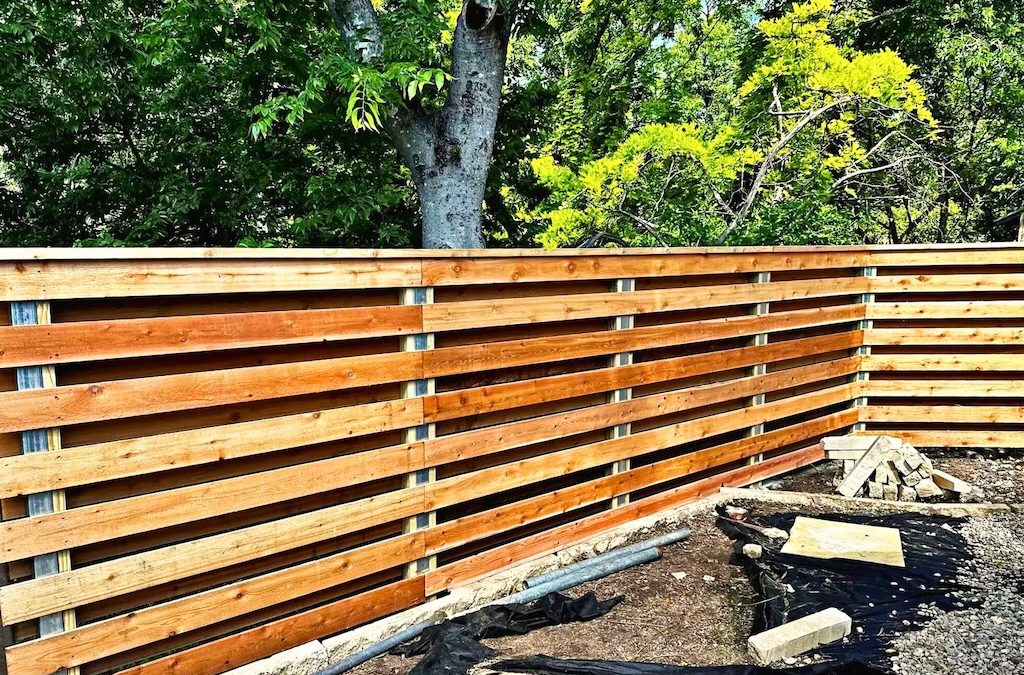
West Lake Hills is steep country
 West Lake Hills lives up to its name. The terrain here rolls and climbs, and plenty of lots have real slope to them. That makes for beautiful, private properties, but it also makes fencing more involved than on a flat yard in town. A fence on a hillside is a different kind of build.
The key is a crew that’s comfortable on a slope and comes prepared for the rocky ground. A team used to flat lots can struggle out here. Our Austin fence company builds on steep West Lake Hills lots regularly, so the grade and the rock are just part of the job, not a surprise that throws off the whole project.
A fence cannot just follow the slope
The core challenge is that a fence panel is a rigid rectangle, and the ground underneath it is tilted. You can’t just lay panels flat against a hillside, they’d leave big triangular gaps at the bottom on the downhill side. So a steep-lot fence has to be built in a way that deals with the grade on purpose.
There are two main methods for this, and picking the right one is where experience comes in. Both keep the fence looking intentional and closed off, rather than a patchwork of gaps. Which one fits depends on your fence style and just how steep the slope is, and it’s a call best made on site looking at the actual land.
Stepping the fence
The first method is stepping. Each section of fence stays level, and the whole run drops down the slope in steps, like a staircase. It gives a clean, structured look, with each panel square and horizontal, and it works especially well with solid privacy panels that need to stay level to look right.
The trade-off with stepping is that it leaves a small gap under each panel where the ground falls away, which grows on steeper grades. On a privacy fence that can matter, so those gaps sometimes get filled or the steps kept short. Done thoughtfully, stepping gives a steep-lot fence a crisp, deliberate look that suits many homes.
Racking the fence
The second method is racking, sometimes called raking. Here the panels flex to follow the slope, so the fence angles smoothly along the grade with the top and bottom rails parallel to the ground. It hugs the hillside, leaving no gaps underneath, which is a big advantage on a steep or uneven lot.
Racking gives a continuous, flowing look rather than a stair-step, and it’s often the better choice for open styles like iron on a slope. Not every panel style racks well, though, so it depends on the fence. Between stepping and racking, a crew that knows slopes will pick whichever gives you the cleanest, gap-free result for your yard.
The rocky ground factor
On top of the slope, West Lake Hills brings the classic Hill Country ground: limestone and caliche, hard rock near the surface. Digging post holes here is a real job that takes heavier tools like rock drills to reach a proper depth. It’s slower than digging soft soil, and that’s normal for the area.
The payoff is a rock-solid anchor. Once a post is set firmly into that rock, it holds tight and doesn’t shift like a post in clay would. On a steep lot, where the fence is already working against gravity, having posts locked into stable rock is a real advantage. It just takes the right equipment and know-how.
Solid posts matter even more on a slope
On any fence, the posts are everything, but on a steep lot they carry even more load. Gravity and runoff both work on a hillside fence, so the posts have to be set deep and solid to keep the whole run from creeping or leaning downhill over time. Skimp on the posts here and the slope will find the weakness.
That’s why we don’t cut corners on the foundation of a steep-lot fence. Proper depth, solid footing, and correct spacing for the grade are what keep the fence standing straight for years. The panels get the attention, but on a slope it’s really the posts underneath that determine whether the fence lasts.
Drainage and erosion on a hillside
Water behaves differently on a slope, and it matters for your fence. Rain runs downhill and can channel right along a fence line, eroding soil around the posts and undermining them over time. On a steep lot, thinking about where water goes is part of building a fence that stays put.
A well-planned fence works with the drainage rather than damming it up, so runoff doesn’t pool against posts or wash out the footing. On erosion-prone hillsides this is a real consideration. Planning the layout with water in mind is one more reason steep-lot fencing rewards a crew that understands the terrain, not just fences.
Keeping a steep-lot fence healthy
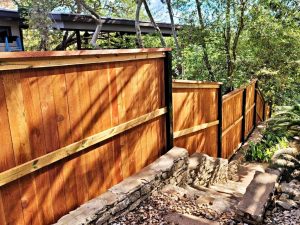 Once a steep-lot fence is up, a little upkeep keeps it solid. The slope and the weather work on it over time, so it’s worth walking the line now and then to check the posts, especially after heavy rain that can wash soil away from the footings. Catching a loosening post early is a lot easier than fixing a slid section.
Keep an eye on the drainage, too. If you notice water carving a channel along the fence or pooling against a post, that’s the kind of thing that undermines a hillside fence if it’s ignored. A quick fix to redirect the runoff protects the posts and keeps the whole run standing straight on the slope.
Wood on an exposed hillside needs its stain kept up as well, since these lots often catch full sun. None of it’s hard, it’s just worth staying on top of. Handle the small stuff and a steep-lot fence lasts every bit as long as one on flat ground, and it keeps looking clean the whole time.
Building a steep-lot fence right
Put it together and a steep lot is very fencible, it just takes the right approach: the correct method for the grade, solid posts drilled into the rock, and a plan that accounts for drainage. Handle those, and you get a fence that looks clean and holds tight instead of one that sags and gaps within a few years.
We build steep-lot fences throughout West Lake Hills and the surrounding hills, so we read the grade and plan the build from the first walk-through. If you’ve got a slope that’s been giving you pause, a solid fence installation on it is absolutely doable. Our fence inspection guide also helps you keep a hillside fence healthy once it’s up.
Quick Answers
How do you build a fence on a steep lot?
Two ways: stepping the panels down the slope like stairs to keep each one level, or racking the panels to flex and follow the grade smoothly. Both sit on solid posts, and the right choice depends on your style and the steepness.
What's the difference between stepping and racking?
Stepping keeps each panel level and drops the run in stair-like steps, leaving small gaps under each on steeper ground. Racking angles the panels to follow the slope with no gaps underneath. Racking suits open styles; stepping suits solid privacy panels.
Is it harder to build a fence in West Lake Hills?
It takes more planning, because of both the steep slopes and the rocky limestone ground. With the right methods and tools it’s very doable, and posts set into rock hold tight, which helps on a hillside.
Why do posts matter more on a steep lot?
Gravity and runoff both pull on a hillside fence, so posts have to be set deep and solid to keep the run from creeping or leaning downhill. On a slope, the posts underneath determine whether the fence lasts.
Does drainage affect a hillside fence?
Yes. Rain runs downhill and can channel along the fence line, eroding soil around the posts. A well-planned steep-lot fence works with the drainage so runoff doesn’t wash out the footing over time.
Got a steep West Lake Hills lot? We’ll build a fence that fits the slope. We’re fully insured. Call (512) 566-7567 or get a free estimate.