
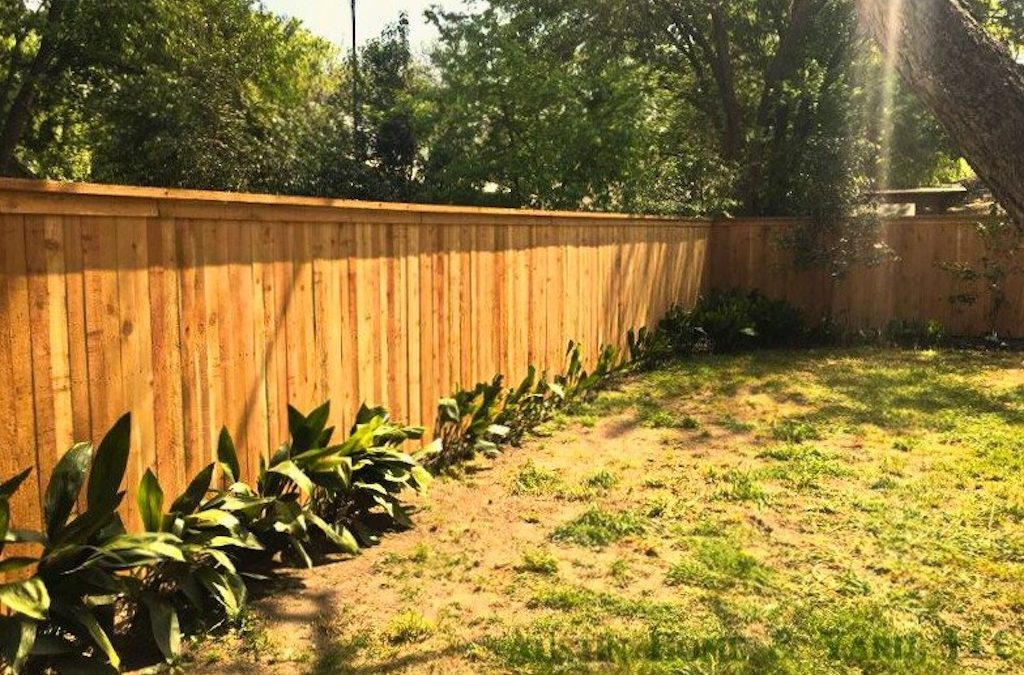
Why post depth is such a big deal
 Post depth might sound like a small technical detail, but it’s one of the most important things about your whole fence. The posts hold everything up, and how deep and how well they’re set decides whether your fence stands straight for decades or starts leaning in a few years. It’s the part you can’t see that matters most.
This is especially true here, where our soil is famously hard on fences. Get the depth right and a fence rides out our conditions beautifully. Get it wrong and even a gorgeous fence will lean. Our Austin fence team treats posts as the foundation of the job, because in this soil, that’s exactly what they are.
The general rule of thumb
The classic guideline is to bury about a third of the post’s total length, or put another way, roughly a third of the fence’s above-ground height. So for a standard 6-foot fence, that points to posts set somewhere around 2 feet deep as a baseline. Taller fences call for deeper posts, since they catch more wind and leverage.
That rule is a starting point, not a hard law. It gives you a sense of the ballpark, but the real answer depends on your specific fence and, just as much, on your soil. In many Austin yards, that baseline is the minimum, and going deeper is the smart move rather than the exception.
Why Austin soil changes the math
Here’s what makes our area different: much of the Austin metro sits on expansive clay, especially the Blackland clay to the east. This soil swells when it’s wet and shrinks when it dries, moving through the seasons. That constant movement grabs at fence posts and, over time, pushes them out of line.
Because of that, a post set only to the bare-minimum depth can still get shoved around by the clay. Setting posts deeper, below the zone where the soil moves the most, gives them a grip on more stable ground underneath. That extra depth is your best defense against the leaning that plagues fences in this soil.
Taller fences need deeper posts
The height of your fence drives the depth too. A tall privacy fence is a big sail that catches a lot of wind, and it has more leverage trying to tip the posts. So a 6-foot or 8-foot fence needs posts set deeper than a low 3-foot fence would, simply to hold all that height steady against the wind.
This is why there’s no single magic number that fits every fence. A short garden fence and a tall privacy fence in the same yard call for different post depths. Matching the depth to the height, and then adding for our soil and wind, is how you land on the right number for a specific fence.
Depth is not the only thing
Here’s a point people miss: a deep post that’s set poorly can still fail. How the post is secured matters as much as how far down it goes. The footing has to be solid and packed properly around the post, with no gaps for water to collect and no wiggle room for the clay to work into over time.
Done right, with the correct depth and a firm, well-packed footing, a post grips the ground and stays put through years of wet-dry cycles. Done sloppily, even a deep post can loosen. So the goal isn’t just deep, it’s deep and solid. Both together are what give you a fence that holds its line.
What happens when posts are too shallow
When posts are set too shallow for the fence and the soil, the results show up within a few years. The fence starts to lean, posts wobble when you push on them, gaps open at the bottom as things shift, and gates that once closed cleanly start to stick. It’s the classic sign of a foundation that wasn’t set deep enough.
The frustrating part is that this often happens to a fence that looked perfect on day one. Shallow posts are a shortcut that saves a little time up front and costs a lot later, since fixing a leaning fence means resetting posts anyway. Our fence inspection guide helps you catch early signs before they spread.
Repair or rebuild in this soil
If just a post or two have shifted, resetting them deeper usually solves it. We dig the post out, set it at a proper depth, and pack it solid so it stops moving. Done right, that post won’t lean again, and the rest of the fence keeps doing its job. It’s a targeted fix for a targeted problem.
If many posts were set too shallow and the fence is leaning all over, a rebuild set deeper from the start is often the smarter long-term move than chasing one post at a time. Our repair or replace guide helps you weigh it. In our clay, whichever route you take, it comes back to proper depth.
Does concrete matter for posts?
 A question that comes up a lot is whether fence posts need concrete. Concrete can help anchor a post, but it’s not a magic fix on its own, and in our clay it has to be done right. A post set in a small plug of concrete that doesn’t reach proper depth can actually heave as a unit when the soil moves.
What matters more than concrete versus no concrete is that the post reaches the right depth and is packed solid with no gaps for water. Done well, whether with concrete or a properly tamped footing, the post grips stable ground and stays put. Done poorly, concrete alone won’t save a post that’s too shallow for our soil.
This is exactly the kind of detail a crew that knows local soil gets right without you having to think about it. We set posts to the depth and with the footing your fence and your ground call for, so they hold. If you’ve wondered why one fence leans and another doesn’t, this is usually where the answer lives.
Getting your post depth right
The bottom line is that there’s no one-size-fits-all number, but the principle is simple: set posts deep enough for your fence height, deeper still for our shifting clay, and always set them solidly. Get that right and you’ve built the foundation for a fence that stays straight for the long haul.
This is exactly the kind of thing a crew that knows local soil handles without you having to think about it. When we build a fence installation or hang a gate for homeowners around Austin, we set the posts for the fence and the soil, so your fence is built to last from the first hole. Deep, solid posts really are the whole secret.
Quick Answers
How deep should fence posts be?
A common rule is about a third of the fence’s above-ground height, so a 6-foot fence often means posts around 2 feet deep or more. In our shifting clay soil, deeper is usually better, and taller fences need deeper posts.
Why do Austin fence posts need to go deeper?
Much of the metro sits on expansive clay that swells and shrinks with the seasons, pushing on posts. Setting them deeper, below the zone where the soil moves most, gives them a grip on stable ground and prevents leaning.
Does fence height affect post depth?
Yes. A taller fence catches more wind and has more leverage to tip the posts, so a 6-foot or 8-foot fence needs deeper posts than a low 3-foot fence. Depth is matched to height, then added for soil and wind.
Is depth the only thing that matters for posts?
No. How the post is set matters as much as how deep it goes. The footing must be solid and packed with no gaps for water or wiggle room. A deep post set poorly can still loosen, so it’s deep and solid together.
What happens if fence posts are too shallow?
Within a few years the fence starts to lean, posts wobble, gaps open at the bottom, and gates stick. Shallow posts are a shortcut that costs more later, since fixing a leaning fence means resetting posts anyway.
Want a fence set deep and solid for our soil? That’s how we build. We’re fully insured. Call (512) 566-7567 or get a free estimate.