

A leaning fence can often be saved, especially if the boards and rails are still sound and only the posts have shifted. Resetting or reinforcing the posts straightens many fences without a full rebuild. It’s usually too far gone when the wood is rotting throughout or most of the posts have failed across the whole run.
A lean is not always a death sentence
 A leaning fence looks alarming, and people often assume it means a whole new fence. Good news: a lot of the time, that’s not true. Plenty of leaning fences can be straightened and saved without tearing everything out, as long as the problem is caught before it spreads too far. A lean is a warning, not always a verdict.
The trick is knowing when a lean is fixable and when it’s genuinely past saving. That comes down to what’s actually failing, the posts, the wood, or both. Our Austin fence company straightens fences all the time that owners assumed were goners, so it’s worth understanding before you write yours off.
Why fences lean in the first place
Most leaning around here traces back to the soil. Our clay swells when wet and shrinks when dry, and that constant movement pushes on fence posts season after season until they tilt. Posts set too shallow lean first and worst, since they don’t have the depth to resist all that shifting.
Wind, rot, and time pile on too. A big storm can shove a fence, water can soften the ground and the posts, and years of wear loosen things up. But underneath most leans is a post problem, the posts have lost their solid grip on the ground. That’s the key, because posts are usually fixable.
When a leaning fence can be saved
Here’s the encouraging part. If your fence is leaning but the boards, rails, and most of the structure are still in good shape, and the issue is mainly that some posts have shifted, it can very likely be saved. Sound wood plus a post problem is the ideal case for a repair rather than a replacement.
In that situation, straightening the fence is really about fixing the posts. The good bones you already have, the boards and rails, stay right where they are. You’re restoring the foundation, not rebuilding the whole thing. That’s why a lean caught while the wood is still solid is so often a save, not a loss.
How resetting posts works
Saving a leaning fence usually means resetting the affected posts. We dig out the leaning post, straighten it back to plumb, and re-secure it at a proper depth with a solid, well-packed footing. Set right this time, it grips the ground and holds, so the fence stands straight again and stays that way.
Sometimes a post can be reinforced rather than fully dug out, depending on its condition and how it was originally set. Either way, the goal is a post that’s solid and deep enough to resist the soil movement that caused the lean in the first place. Fix the posts properly, and the lean is gone for good, not just for now.
When it is too far gone
Not every leaning fence can be rescued, and it’s fair to be honest about that. If the wood itself is failing, boards rotting, rails crumbling, widespread soft or gray wood, then straightening the posts just props up a fence that’s dying anyway. At that point you’re patching a fence with no good years left.
Same story if most of the posts have failed across the whole run, not just a few. Resetting one or two posts is a targeted repair, but rebuilding the foundation post by post along the entire fence rarely makes sense. When the rot is everywhere or the posts are gone throughout, replacement is usually the smarter call.
How to tell which one you have
A few checks tell you a lot. Push on the posts, do they wobble, or are most still solid with just a few loose? Poke the wood near the ground, is it firm, or does a screwdriver sink into soft, rotting boards? Look down the whole run, is it one leaning section, or is the entire fence going?
Solid wood plus a few shifted posts points to a repair. Widespread rot plus posts failing everywhere points to replacement. If you’re not sure, that’s exactly what an inspection is for. Our fence inspection guide walks through what to look for so you can size up your own fence before you call anyone.
Do not wait too long
Timing really matters with a lean. A fence that’s just started to tilt is far easier and cheaper to save than one that’s been leaning for a year and dragged its neighbors down with it. A small lean caught early is a quick post reset. Left alone, it strains the whole fence until a simple fix becomes a big one.
A lean also tends to get worse, not better, since the same soil movement keeps working on it. So if you notice your fence starting to tip, that’s the moment to act, while it’s still firmly in save-able territory. Catching it early is often the difference between a repair and a replacement.
Reinforcing versus a full reset
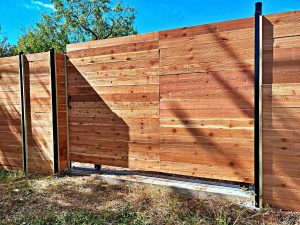 It’s worth knowing there’s a range of fixes for a lean, not just one. A post that’s shifted but still sound can sometimes be braced or reinforced rather than fully dug out and reset, which is quicker. A post that’s loose or starting to rot usually needs a full reset at proper depth to really hold.
The right fix depends on the post’s condition and how it was set to begin with. That’s why a look at the actual fence matters, since the best approach isn’t always obvious from a distance. A good crew reads each post and picks the fix that’ll last, rather than a patch that lets the lean creep back in a season.
Whatever the method, the aim is the same: a post that’s solid and deep enough to resist the soil movement that caused the lean. Get that right and the fence stands straight for years, not months. That’s the difference between truly saving a leaning fence and just propping it up until the next wet-dry swing shoves it over.
Getting your fence straight again
The takeaway is hopeful: don’t assume a leaning fence is done for. If the wood’s still good and the posts are the problem, there’s a strong chance it can be straightened and saved, often for far less than a new fence. It’s always worth having it looked at before you commit to a full replacement.
We straighten and save leaning fences for homeowners across Austin all the time, and when a fence is truly past it, we’ll tell you that straight too. Whether it needs a fence repair or it’s time to weigh a rebuild with our repair or replace guide, we’ll give you an honest read and get your fence standing right again.
Quick Answers
Can a leaning fence be fixed?
Often yes, especially if the boards and rails are still sound and only the posts have shifted. Resetting or reinforcing the posts straightens many fences without a full rebuild. It’s a common, affordable repair.
How do you fix a leaning fence?
Usually by resetting the affected posts: digging out the leaning post, straightening it to plumb, and re-securing it deeper with a solid footing. Sometimes a post can be reinforced instead. Set right, the fence stands straight again.
When is a leaning fence too far gone?
When the wood is failing throughout, with widespread rot and soft or gray boards, or when most of the posts have failed across the whole run. Then straightening the posts just props up a dying fence, and replacement is smarter.
Why is my fence leaning?
Usually the soil. Our clay swells and shrinks, pushing on posts until they tilt, and shallow posts lean first. Wind, rot, and time add to it, but underneath most leans is a post that’s lost its grip, which is often fixable.
Should I fix a leaning fence right away?
Yes. A fence that’s just started to tilt is far easier and cheaper to save than one that’s leaned for a year. A lean tends to worsen as the soil keeps working on it, so catching it early often means a repair instead of a replacement.
Fence starting to lean? We’ll tell you if it can be saved, and save it. We’re fully insured. Call (512) 566-7567 or get a free estimate.